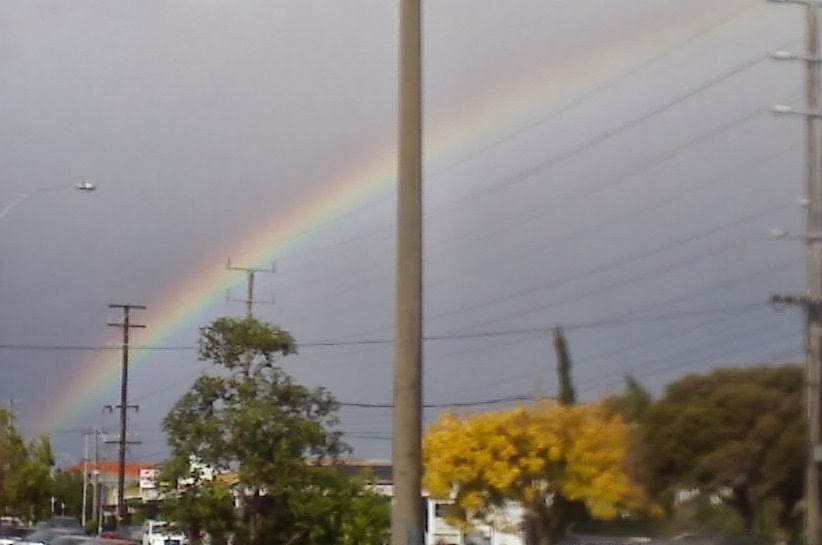
Rainbow over the minicipality

Rainbow over the minicipality

Friday, 9 September 2016

About Wool.


I am not a Vegan.  I drink milk and consume the products of the Cow.  I eat honey and wear woollen clothes.  I like to think that only contented cows give milk, ensuring that my cows’ lives are not unduly unpleasant on my account.  I like to remember that they would not be alive at all if it were not for my milk consumption, and surely any life is better than no life.  If all the World became Vegan, then our Domesticated Cattle species would be reduced to a few examples in zoos and eventually become totally extinct – after millennia of a symbiotic, ecological relationship.

However, there are ways of the world that I wish were different, and wool is one.  My personal experiences ‘in the bush’ have been minimal and long, long ago, but I did go out one day in the rain and help ‘mark’ the lambs, as I recall the name for putting a tight rubber band on all their tails and round all the baby rams’ balls, so they would all fall off and avoid ‘dags and create weathers.  At least they were not using the traditional method of two bricks.  On another occasion, I saw a paddock full of rams and I understand why farms do what they do and why most people are better off remaining ignorant, unlike myself with my single day’s experience.

One hopes that even lambs being led to be slaughtered have at least had a few happy moments experiencing maternal love of the sort that was a popular topic for artists through the Middle Ages and into the Renaissance.  Surely those few moments of transcendent bliss are sufficient to make their short lives worthwhile.  As a species, we like to imagine ourselves outside the Natural Order, but it is the nature inherent in each living being that comes into life to ultimately be food for some other, larger creature: Nature is constantly consuming itself.  Only our species, at the pinnacle of the food-chain die uneaten, only to eventually be consumed by worms or bacteria.

While I feel that being Vegetarian is right for me, I cannot bring myself to become a Vegan, because the products of the animals are different from the animals themselves.  However, I recognise that the industries that make these products available, derived from ancient cottage-industries, have a negative side that is best kept out of sight.  Instead of campaigning for the world to become Vegan, activists would have more chance of meaningful results by campaigning for better rights for the animals that give their products instead of ignoring them in the wider claim to end all animal farming.

Sunday, 28 August 2016

Wednesday, 24 August 2016

the Melbourne Grand Prix


Opposition to the Melbourne Grand Prix is a bourgeois plot to denigrate a Working Class sport.  The emphasis on the overuse of a public park for an event with limited class appeal appears to support the rights of ordinary people – class unspecified, and also has an environmental aspect that immediately co-joins this issue with the social groups and ideas that are called ‘the left’.  

It might be argued against this idea by pointing out the elitist domination of the Grand Prix by ‘big, international money’ and the exclusive use of some of its facilities by that small group, and then noting that these people are reviled by opponents of the Grand Prix.  The very small, very wealthy, global elite, the five percent of the population that owns ninety five percent of everything, a ratio that has remained similar throughout human history since Classical times and probably before, are the contemporary version of an Aristocricy, while the Middle Class and Working Class might be approximately be assumed to be forty percent each with a five percent ‘under class’. 

Before the French Revolution there were moves to align the peasantry with the aristocracy against the middle class who were the leaders of the revolution.  Still today, most of our Greens, Socialists and so forth on the ‘left’ are the well-educated children of the old middle class.  Working Class suburbs are always more conservative, for example supporting the Monarchy.  Socialist Governments are mostly run by a middle class sub-class of the highly educated, supposedly on behalf of the Working Class who are assumed to be unable to govern themselves without being led by theorists and activists.  

After the Russian Revolution’s blatant social failures emerged after the first world war, the German left agreed to work with the old upper class for the sake of social stability.  It led to later problems but this is not the place for detailed history of the different class groupings though history.  These two classes share other aspects because they are the two original classes before the rise of the middle class.  They are both ‘earthy’ in the sense of swearing and carnal relationships compared to the middle class’s puritan approach to both.  They are also both public compared to the highly prized privacy of the middle class, because the working class live in crowded, public conditions and the upper class live overt, public lives as exhibitionists, though now days only in private.  It is little wonder that Motor Racing should appeal to the extremes of the Social Ladder: Gasoline Alley and the many motor racing princes.  While the Working Class are powerless to end the negativity towards their sport, the other end of the social spectrum are probably amused that the trendy, bourgeois activists oppose them and laugh at ignorant denigration.

Instead of opposition, the aim should be to take maximum advantage of the Grand Prix.  For example, the much derided pit buildings and temporary facilities for the international, high-paying visitors could be year-round facilities for park users.  Indeed, the effort to preserve the park for public use really only helps a small number of park users, compared to similar areas in other places, and a further criticism could be that if the park is to be saved for anything it is to revive ‘Country’.  

A further suggestion will be ridiculed by those who now oppose the Grand Prix, and that is to make it the Royal Melbourne Grand Prix.  There is a valid criticism that internationally few people know it is the Melbourne Grand Prix and not the Australian Grand Prix, so the City does not earn all the global publicity for which it pays dearly.  Making it the Royal Melbourne Grand Prix would ensure the name was clear and unambiguous, as well as unique.  The way to make the event truly Royal would be to start it with a carriage race.  After all, motor vehicles derive from the horse-drawn vehicles. 

HRH the Duke of Edinburgh helped develop carriage racing as a competitive sport and raced himself until recently.  An approach to be patron of such a new vehicle racing sport in conjunction with motor racing might appeal to His Royal Highness.  How horses galloping down the circuit would affect the road surface might be a consideration of the sort that bursts bubbles.

It would be interesting to make this a truly Working Class festival, unabashedly so.  With interests and advertising that appeal to Working Class people that derive from their own interests and activities, not alcohol and so forth sold to working class people by big middle class companies.  For example, the Churches could be sponsors, because there is nothing ‘sinful’ about cars and working on them is good, honest ‘work’. The end of greyhound racing in NSW is similar, with issues over the well-being of the dogs the excuse to terminate a largely working class sport.  There is an ironic inconsistency in people who eat meat without thinking about the conditions of the lives or deaths of their food but stress over the deaths of dogs, and it is even more inconsistent with a world where millions of people are suffering more than the dogs, including some in Australia: the dogs can only be an excuse.

If we are to have the Grand Prix, it should pay for itself.  Being able to include it in our list of International Sporting Fixtures, to support our claim to be World Sporting Capital, comes at a great cost.  Melbourne remains a car city; while over eighty percent of private journeys in London are on Public Transport, it is less than twenty percent in Melbourne (ref mislaid).  We can’t extend the trams and trains significantly, but we could replace half the cars on the road with buses.  Non-polluting buses that use fuel cells as in many other countries could be built here to replace our now defunct car manufacturing industries, but for some reason we spend more on roads for cars.  We sure do love our cars!
Tuesday, 23 August 2016

A Couple of Mates


Let us call him James.  He went with, let you and I call him Don, to Tasmania bush-walking.  James was accomplished and did it often, abseiling and rock-climbing to reach magnificent, inaccessible places.  I was envious because I would have liked to be taken, though now I think of it, I never asked.  They came back rather faster than anticipated, and stayed at my place so no one in their home town would know they hadn’t stayed as long as planned.  I knew another guy years ago, from that same town but no connection, who had taken a job in a lighthouse, promising us all that he looked forward to the solitude; he returned after a couple of weeks and joined the Army!!

It was always my suspicion that something had happened between them.  A few years earlier, James had kissed me.  Once, sensuously but briefly, before glided away and we never spoke of it again.  I wondered if the same sort of thing had happened while they were in the bush.  Don managed to be unobtrusively heterosexual in a non-aggressive, non-macho way.  It was at a time when people were just learning how to raise the collective consciousness of social gatherings.  It may have been a New Year’s Eve late last Century when both James and I floated past each other, briefly alighting on a pile of coats and scarves on a bed in the dark. 

James, as we are calling him, had a Mother from Pakistan.  I believe he inherited the Sensuousness that pervades many cultures in the Middle East as portrayed in the 1001 Nights and Omar Khayyam’s Rubaiyat.  Pleasurable physical contact between people need not be sexual.  In countries with total and strict gender segregation, many men behave as do many other men do in prisons or on ships – for the duration.  After a time, he married a charming lady from Scandinavia, who must have found him exotic, though born and raised in Australia and being half Anglo-Celtic he was also like an average local

It was so long ago that I didn’t know what I was, or indeed that I could be anything in particular at all.  Looking back with present knowledge at times long past can be revealing.  Don was well ahead of his time.  In today’s contexts, he could have been gay or straight, it was hard to tell.  Certainly, he displayed none of the overt masculine behaviour of flirting, and certainly never inappropriate behaviour, though he did move in early, liberated political circles.  It was only many years later, but still many years ago, that I returned to the town for a reunion and a party and saw Don in the arms of a woman.  When I commented on it, all the other women in the room laughed and I was told that they had all been one of Don’s ‘conquests’ at one time or another, he was just very, very discreet.  They had all found out a couple of years previously when he invited them all to his birthday party, I won’t reveal which one, and he gave them each a rose and owned up to his infidelities.  

Did I mention that Don was little bloke who didn’t say much, but who was really good at football, all codes, as well as ball games played with sticks or balls and hoops?  He was very popular and had no enemies, so all the husbands, brothers, fathers and sons of the ladies with whom he dallied accepted it as quite natural that it should be so, and were pleased their wives, sisters, daughters and mothers were included.  The only women missing were the visible girl-friends that he had been known to occasionally and briefly have tragically ended relationships, but they had not been at that party nor the one I was attending.  Might I also mention that little Don also worked at the Tax Department, so he probably knew everything about everyone, but was very discreet about that too?