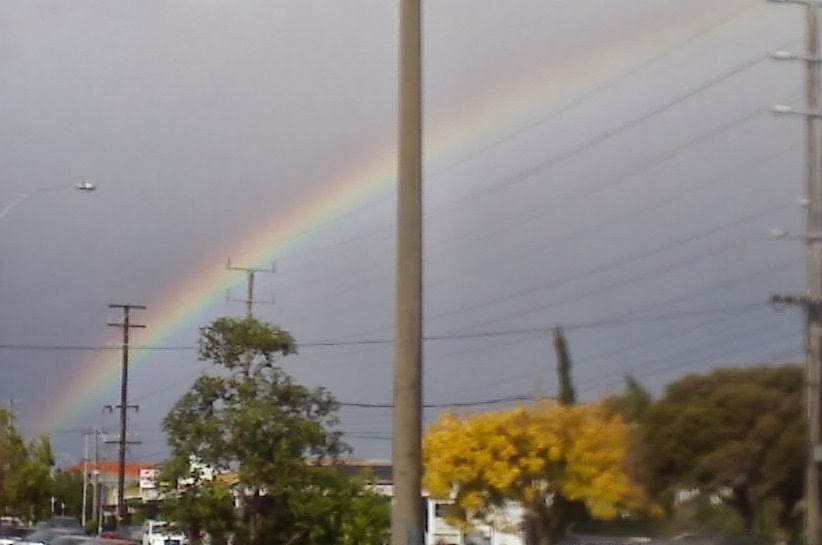
Rainbow over the minicipality

Rainbow over the minicipality
Showing posts with label environment. Show all posts

Friday, 1 September 2017

Living in our 4-D world.

Living in our 4-D world.
When we look around us, we see a 2-D projection of our visual field, through circuits that criss-cross our brains, onto our visual cortex, which provides us with the cyclorama in which we behave.  Our vision of the world is always like a flat picture, but one with depth because of our binary vision.
When we close our eyes, we are not limited to seeing (with our minds eye) what is in front of us, but we can, in our minds, see all around us.
When we look at a flat picture, we are looking at it from outside of it.  If our point of view was in the picture, we would only see the immediate surrounding pixels, because we would be within a pixel, using computer jargon.  This concept has been well described in literature.
When we imagine the world around us while not observing it, we may imagine ourselves immersed in it.  The new immersive, virtual, binocular perceptual inventions are based on this principle.  When we put on the headset, we are presented with a construction of what we would see in a picture of the direction of view, that gives the illusion of existing within the imaginary reality.  It is constructed mathematically using rays and vectors and whatever based on the idea that the observer is within the scene.
We are deemed to exist within a single pixel, or perhaps a pair of close pixels, so we are similarly only able to see the surrounding pixels.  However, because most (where the air is) are transparent, we can see a lot of structure all around.
Some people are probably better at this than others.  It is part of our psycho-physiological development that we learn to navigate the 3-D world of which our bodies are part.  How well we conceptualise ourselves as existing within spatial dimensions must vary.  Reading literature is recommended to develop this.
It is also possible to imagine the world around oneself without being inside it, but as an outside observer of the space one inhabits.  One would see ones physical body from all sides as existing within the world, but one wold not be seeing the world from within that body.  It would be an out of body experience.  Many people have reported such experiences, for example swimmers who see themselves from above while they swim up and down in the pool below.  The near death experience includes this sort of perception. 
It must be possible for our brains to construct this sort of perception if it occurs spontaneously for some people in specific, usually extreme circumstances.  Then, it may be possible to develop the ability to see the world that way at will.  Perhaps some Religious, meditative and concentration techniques induce this perception giving rise to the belief that we each have a soul that is somehow outside or beyond the physical universe.  (There are other concepts of soul that are not negated by this argument.)
To recap: We look at a picture from outside the frame, in a totally different dimension.  Even a 3-D picture is viewed from outside the picture and in front of it.  Our perception of the world is of a circular or spherical projection all around us of a picture of what our eyes perceive but a picture that has depth.  We as observers are outside the picture.
Once one has perfected the ability to perceive ones surrounding environment from outside it, then one can start to explore the geometry of this extra-dimensional reality.  Our almost universal, cubical Architecture lends itself to this sort of exploration.  If we see ourselves in a room with a door in each wall, as well as a door in the ceiling and the floor, we can easily imagine ourselves going through that door into the room beyond.  Each room has six doors to the six surrounding rooms. 
Because it is all in the mind, we are not bound to imagine it as the animators present it, with the rooms forming an endless grid, with door on opposite sides opening onto room after room in every direction.  If we return to our 2-D heuristic simplification, we can imagine ourselves in the picture, which we now know is not continuous in every direction but is square.  We can move around within the flat surface and when we reach an edge, we can find a door to the next square.
Squares can repeat endlessly on a flat surface, or they can be wrapped round the sides of a cube.  Six squares form a cube.  If we were in one face, we could reach an edge, and stay on the cube by going through the door at the same time as shifting direction into another dimension, so that we are still in a flat, 2-D space, but within a plane at right angles to where we were.
Returning to 3-D, when we open a door at one side of our room, we can also imagine ourselves changing into another dimension, so that our room is somehow at right angles to the room we left, even though each appears to us, looking down on it, as a normal square room.  Because we have changed direction while we exit/enter a door, the rooms do not extend for ever, but wrap around a tesseract, just as the squares wrap around a cube.  Eight cubes form a tesseract.
It is therefore quite easy to see oneself within the rooms, one by one that wrap round each other.  It has to be done with eyes closed, because as soon as one looks around oneself at the real world, the other dimension collapses and we return to our pseudo-3D perception (2-D with depth) that looks real.  When the sense of changing direction when moving from room to room is perfected, it is possible to dispense with the walls of the room, and see everyone at once.  This is the equivalent of having not a cube with picture-sides, but a transparent cube that one can see inside. 
Higher dimension mathematics tends to describe shapes like the tesseract in terms of their surfaces, edges and points instead of considering the space within.  Architects design the structure, but it is the space within that we inhabit, just as we look at pictures from outside the surface.


Monday, 21 August 2017

Bubbles and stuff


We live in a polarised society.  Within the big bubble of the whole community, people live in social bubbles with invisible boundaries.  These bubbles intersect, and everyone lives in a lot of social bubbles.
New Whig exists in the interstices between the bubbles. Society is like a great foam, full of Social Bubbles.  We are all surrounded by Energy-Fields.  Energy is little understood by Science and even less by most people.  Just as objects of Mass in close contact and moving in unison are equivalent to a single Mass, so people who are socially joined combine their personal Energy Fields.  All Energy is subject to the irrational Wave/Particle Duality, and while we usually think of our Energy being located in a particular spot, namely within our physical bodies, our interactions with other people and with our Social Groups, our Social Bubbles, can only be explained in terms of Energy Fields that exist like bubbles round groups of people.
Foam is the most common structure in the universe.  Indeed, on a large scale, the Universe is a foam, just like the top of frothy, soapy water or where waves break on a sloping beach.  When Astronomers map the zillions of Galaxies that have become visible with orbiting telescopes and whose distance can be quite accurately estimated, we find that it is not an even, grainy distribution, but maps onto huge bubbles, many hundreds of times larger than any galaxy, and while these bubbles appear to be utterly empty, the galaxies we do see are all located in the interstices between the galaxies.  The structure of human cells is very similar: figure and ground.
Where a few bubbles meet there is a multi-filamented nucleus-like blob, and it is within these interstices that galaxy clusters form.  Galaxies can also form along the filaments that exist between three bubbles, some of which are like long tubes, and reach eventually to another blob where another galaxy cluster will form.  How large this foam might be is impossible to say, as our perception is limited to the range in which light can travel before the size of the foam reaches a scale where the foam-expansion exceeds the speed of light.  For indeed, the celestial foam is expanding.  It is like shining a spotlight on a small area of soap foam, counting the zillions of bubbles and then wondering how far the foam extends beyond the light.  We might well imagine that the foam is vastly extensive on a scale that we cannot imaging, and that it, itself is but a speck on the footstool of something yet vastly greater still.   So, Foam is universal.
Within Societies, people (and social creatures including ants and bees) are like the particles in the wave/particle duality, and we all see ourselves that way, but in the real world, there are Energy Fields that interact.  Social Bubbles are made up of groups of linked individuals.  Families are the paradigm. Australia is currently updating its Social Definition of a Family, with some adherents to the Ancient Traditions trying to enclose everyone within their social bubble, while fearing they will either be excluded from what used to be an almost universal social bubble or they will be forced to include within their social bubble some elements that are presently outside the impervious barrier.
[Editors Note: I came up with this heuristic, mental model of Society decades ago, but it sat on my virtual shelf of un-written books.  It is far too complex to describe in full here, and I suppose my use of some terms has put everyone off. Naum Tered]
The difference between Social Bubbles and soap foam is that the people are within the bubbles.  However, if mathematically we replace all the people, who might be like the non-dimensional, dot centres of gravity with the fields they represent, then we have something like the big, open bubbles that make up the universe just like the unseen bubbles in bread and cake. 
Because we all belong to many different bubbles, it is hard to imagine them if they are all transparent, but assigning colour to the bubbles means it is possible to imagine them intersecting with each other.  A two-dimensional version is often used to illustrate Sets and for other organisational reasons and sometimes called Venn Diagrams.  If we want to be really clever we can imagine these bubbles existing in four dimensions where it is possible for otherwise impossible connections to exist, though in some perceptions, seven dimensions is more meaningful.
Politics is like a big balance, where the Social Bubbles on each side weigh up against each other.  Boundaries between the bubbles are not smooth but fractal, and individuals from each side move into the domains of each other, perhaps due to their participation in some other Social Bubble all together, so that they form tendrils that spiral about each other on the boundary. 

Friday, 12 May 2017

The Disaster of the Dingo Proof Fence

Here is another example of long term-Environmental disaster from dumb Colonists not understanding the Australian Ecosystms.
The Dingo Proof Fence

Tuesday, 18 April 2017

Gender segregation is so totally misunderstood.


Gender segregation is so totally misunderstood.  From my experience, and I have had two that are from very different cultures, it is not women being kept in by men, but women keeping men out.
As a Traditional Jew, I recall walking round to the Shul where my Paternal Grand-Father had davened before joining a break-away Minyan a year or so before he died of pneumonia, a couple of years before I was born.  My Grand-Mother had returned, but my Father had stopped doing everything and had fallen out with his Father because of it.  My Parents had been married at an old, assimilated congregation on the other side of the highway, where my Paternal Grand-Parents were apparently not made welcome and never visited again, or so I vaguely recall being told once by some unknown congregant who spoke to me once.
Most of my childhood is a forgotten haze, mostly spent sick in bed, where my cousins all thought I was a lazy malingerer and never ever visited me, even once.  I do recall a single Yom Kippur when my Father and I walked together to see my Grand-Mother.  I remember him being shooed out of the womens section, where everyone was sitting or standing in pious silence, most with a book in hand.  My Grand-Mother sent my Father away immediately, but called me over and we greeted.  I think it was one of the last times I saw her before the last when she was in hospital and gave me a carnation flower to remember her by.  I still have it, put away, somewhere.  I wanted to stay with her, but she told me I couldnt stay because boys were not permitted, and sent me out to find my Father, who was glad to see me because he wanted to go immediately.  I caught only a glance of the Men before being whisked away, thinking that there may have been chamber pots in the womens gallery or perhaps that was just what a lot of women smelt like.  While there was a womens gallery in the Synagogue that I attended every Shabbos and Yom Tov, it had was open to view from the men on the opposite side, with a divided community of men on one side downstairs and women on the other upstairs.  There was a womens section at the back, but that was not curtained off at all.  There used to be someone in the front row there, almost hidden from view by the raised, central reading desk, whom I was told a step-relation had married, but who no longer spoke to us. 
Many decades later, by chance I came to be renting a small stone house in a little town in the central Himalayas, in what is now Utterakhand but had been a separate Kingdom of Kumaon before the British annexed it and it became part of Utter Pradesh.   I had initially been attracted by the tenth century and older Siva Mandirs, a period of Architectural History I had studied at university.  It was very traditional and at first I only met the men who sat round in tea-houses waiting for pilgrims who would pay them a pittance for performing ancient rituals on their behalf.  It was particularly famous since ancient times for helping barren wives.  To my astonishment, the fecundity of the local Priesthood was never credited, even during the annual festival when girls stood all night in the Temple Forecourt holding a lit oil-lamp, while their mothers waited at the side, only leaving their post for an occasional call of nature; I was warned to stay indoors, shutter the windows and lock the door and not to even light a fire to cook or a single wick in my oil lamp by which to read, but I had already heard some of them boasting in the tea-shops of the miraculous success of yet another married lady, recently conceived after a long and fruitless marriage, and drew conclusions.  It may be salient that Kumaoni men were renowned in the British Army for their valour in combat, but they were a different cast from the Brahmins who made me welcome.  After some months renting a town house I started to be invited to family farms that surrounded the town.  They were generally large, multi-story buildings, often of ancient construction, housing extensive, extended families of many generations.  My friends tended to be young and apparently un-married, and many who claimed to be brothers were really cousin-brothers with sibling fathers who had all been raised communally within the family.  The Women ruled the home and its surrounding farm, where they were all the personification of the Goddess Sita, born in the furrow of a plough, consort of Rama, or Parvati, one of the consorts of Siva, whose mountains (euphemism intended) were the most beautiful.  I was made very welcome at some hearths, while in other homes I quickly learnt to keep a respectful distance, sometimes eating round a corner or through a doorway, sometimes out of eye-shot but always within ear-shot.  Is any of this interesting? Suddenly memories are flowing back like the Ganga streams that flowed down the steep hillsides from natural springs near the peaks.  Those women had the freedom to go to town and sometimes did, especially during the Mela, the great annual spring fair when overnight a whole street-length of stalls popped up to line the usually bare road into town and my friends had their busiest day of the year making clay Shiv Linga for families who had their own traditional Priest that they would only see this once a year, often expecting to be accommodated free including food as well as Mantras, when all the women dressed in their most beautiful saris with all their gold anklets, bracelets and ear and nose rings, but they chose not to.  The men had no such freedom at home and I when men were not needed in the fields under the womens supervision they would be sent to town to earn a few rupees by priestly duties.
What happens in traditional Moslem societies I do not know, but having experienced traditional Hindu and Jewish societies, I suspect it is much the same.  It had probably been like that since time immemorial right up to The Prophet of Islam (peace be unto him) who wrote for people who lived in a world where men were excluded from Womens collective space, usually round the hearth and the well. 
Jageshwar had no well but a natural stone bath, that had probably been hollowed out by millennia of bathers.  It was just near the edge of the wide, stone ledge at the bend in the river opposite where funerals are held, though the small stream that cascaded down the mountain at that place may have gouged out its own little stone basin.  This was the Brahma Kund, the Bath of re-birth, where everyone entering the temple was expected to immerse themselves prior to entry.  If you climbed the track up the mountain, the stream gurgled down near the path, and the slower zig-zag path that criss-crossed the direct, steep descent sometimes also crossed the creek.  Not far below the top of the path, where clear sky could be seen up ahead between the remaining trees up to the ridge that curved up and away on either side, and beyond which was an even steeper descent that received little sunlight and was the home to wandering mystics, human sized red monkeys, wild bears and the famous tigers of Kumaun, there is a little temple amongst the trees, like a lot of the temples that dot these hills it is about the size of a childs cubby house, though in the traditional stone design, and is just big enough for a Rishi to sit inside in meditation sometimes for months or supposedly years without moving, some with a permanent Phallic erection, though now days the temples are either empty or have a Shiv Lingum, the votive image of this branch of Hinduism that represents the Penis within the vagina, as the Lingum always protrudes out of the Yoni.  Anyhow, this particular temple has neither inside and cannot be entered, because it has no floor on which to sit in meditation, but instead is full of water that gushes out over the thresh-hold and flows down the mountain.  I bathed regularly in that water, which may have been slightly radio-active or something, because I staggered into Jageshwar, a life-long invalid and am remembering this now, four decades later or more: It was a magick place with healing water.  When I went down to bath each morning I also took my bucket, because to make a cup of tea in my house I had to go up to the forest with an axe for the wood and down to the river with the bucket for the water.   Sometimes when I bathed, the second time I went there to live, Parvati Bhatt came to fill her bucket.  We could not speak as she only knew the local dialect of Kumauni and even less Hindi than myself, but I did discuss marriage with her Father, and might have been living now in Paradise married to a Goddess now, had my own Father not turned up and collected me and brought me back, but that is a story for another day.
The Western Christian perception of those traditional societies has been wrong since first contact.  We understand that in Europe things evolved differently during the last, long Ice Age, that we call the New Stone Age, the Neolithic.  Instead of extended families, primogeniture meant that instead of brothers living together, a single son took everything, while the rest went into the army or the church.  These households had few women and they were vulnerable, so they were kept protected, particularly from the soldiers that would frequently marauder through the local countryside on their way to do battle against enemies they did not know for their landlords whom they respected but also did not know, who would often rape and pillage in the process of extracting taxation and supplies for their armies.  This is the social pattern that Europeans see when they look at other cultures, so that when they see a society that divides along gender lines and tends to keep the sexes separate, they assume that the women are being kept in, but in reality the men are being kept out.
 Naum Tered
18-4-17