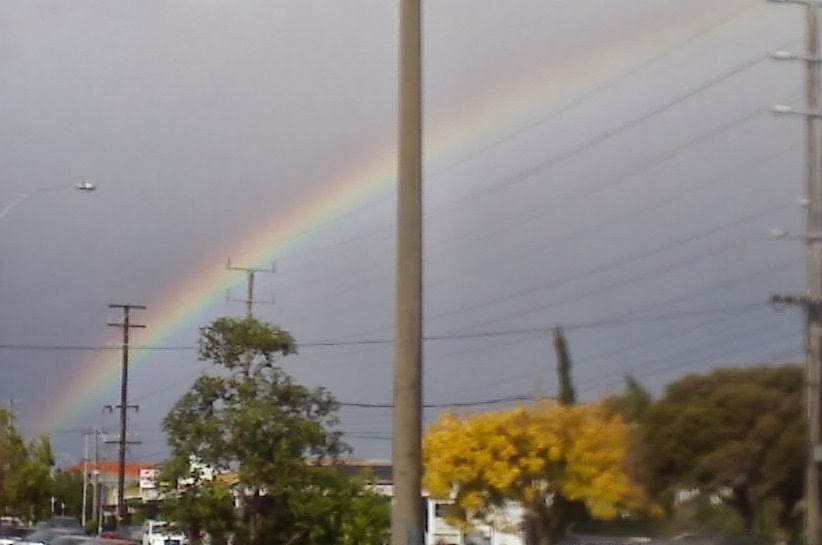
Rainbow over the minicipality

Rainbow over the minicipality
Showing posts with label hyperspace. Show all posts

Friday, 1 September 2017

Living in our 4-D world.

Living in our 4-D world.
When we look around us, we see a 2-D projection of our visual field, through circuits that criss-cross our brains, onto our visual cortex, which provides us with the cyclorama in which we behave.  Our vision of the world is always like a flat picture, but one with depth because of our binary vision.
When we close our eyes, we are not limited to seeing (with our minds eye) what is in front of us, but we can, in our minds, see all around us.
When we look at a flat picture, we are looking at it from outside of it.  If our point of view was in the picture, we would only see the immediate surrounding pixels, because we would be within a pixel, using computer jargon.  This concept has been well described in literature.
When we imagine the world around us while not observing it, we may imagine ourselves immersed in it.  The new immersive, virtual, binocular perceptual inventions are based on this principle.  When we put on the headset, we are presented with a construction of what we would see in a picture of the direction of view, that gives the illusion of existing within the imaginary reality.  It is constructed mathematically using rays and vectors and whatever based on the idea that the observer is within the scene.
We are deemed to exist within a single pixel, or perhaps a pair of close pixels, so we are similarly only able to see the surrounding pixels.  However, because most (where the air is) are transparent, we can see a lot of structure all around.
Some people are probably better at this than others.  It is part of our psycho-physiological development that we learn to navigate the 3-D world of which our bodies are part.  How well we conceptualise ourselves as existing within spatial dimensions must vary.  Reading literature is recommended to develop this.
It is also possible to imagine the world around oneself without being inside it, but as an outside observer of the space one inhabits.  One would see ones physical body from all sides as existing within the world, but one wold not be seeing the world from within that body.  It would be an out of body experience.  Many people have reported such experiences, for example swimmers who see themselves from above while they swim up and down in the pool below.  The near death experience includes this sort of perception. 
It must be possible for our brains to construct this sort of perception if it occurs spontaneously for some people in specific, usually extreme circumstances.  Then, it may be possible to develop the ability to see the world that way at will.  Perhaps some Religious, meditative and concentration techniques induce this perception giving rise to the belief that we each have a soul that is somehow outside or beyond the physical universe.  (There are other concepts of soul that are not negated by this argument.)
To recap: We look at a picture from outside the frame, in a totally different dimension.  Even a 3-D picture is viewed from outside the picture and in front of it.  Our perception of the world is of a circular or spherical projection all around us of a picture of what our eyes perceive but a picture that has depth.  We as observers are outside the picture.
Once one has perfected the ability to perceive ones surrounding environment from outside it, then one can start to explore the geometry of this extra-dimensional reality.  Our almost universal, cubical Architecture lends itself to this sort of exploration.  If we see ourselves in a room with a door in each wall, as well as a door in the ceiling and the floor, we can easily imagine ourselves going through that door into the room beyond.  Each room has six doors to the six surrounding rooms. 
Because it is all in the mind, we are not bound to imagine it as the animators present it, with the rooms forming an endless grid, with door on opposite sides opening onto room after room in every direction.  If we return to our 2-D heuristic simplification, we can imagine ourselves in the picture, which we now know is not continuous in every direction but is square.  We can move around within the flat surface and when we reach an edge, we can find a door to the next square.
Squares can repeat endlessly on a flat surface, or they can be wrapped round the sides of a cube.  Six squares form a cube.  If we were in one face, we could reach an edge, and stay on the cube by going through the door at the same time as shifting direction into another dimension, so that we are still in a flat, 2-D space, but within a plane at right angles to where we were.
Returning to 3-D, when we open a door at one side of our room, we can also imagine ourselves changing into another dimension, so that our room is somehow at right angles to the room we left, even though each appears to us, looking down on it, as a normal square room.  Because we have changed direction while we exit/enter a door, the rooms do not extend for ever, but wrap around a tesseract, just as the squares wrap around a cube.  Eight cubes form a tesseract.
It is therefore quite easy to see oneself within the rooms, one by one that wrap round each other.  It has to be done with eyes closed, because as soon as one looks around oneself at the real world, the other dimension collapses and we return to our pseudo-3D perception (2-D with depth) that looks real.  When the sense of changing direction when moving from room to room is perfected, it is possible to dispense with the walls of the room, and see everyone at once.  This is the equivalent of having not a cube with picture-sides, but a transparent cube that one can see inside. 
Higher dimension mathematics tends to describe shapes like the tesseract in terms of their surfaces, edges and points instead of considering the space within.  Architects design the structure, but it is the space within that we inhabit, just as we look at pictures from outside the surface.


Monday, 14 September 2015

ERST

I have just invented a new acronym, ERST.
It stands for Electronically Recorded, Stored and Transmitted and I used it first when describing my latest version of the Melba Opera House, because it neen not be the biggest, best and most iconic Opera House, but it must ERST ready.
How do people call these things now?  Do we even have a vocabulary specifically for the virtual world that eventually people will inhabit as much or more than the so called "real world". Perhaps I am one of the few who has explored living in our world as if it had another dimension.  Mathematicians must all do it, because so much of mathematics accpet that real numbers are only a subset of numbers.  To calculate electronics that has our of phase oscilating electrical currents, it is necessary to use formulae that include complex numbers but the final result always turns out to be an expression with only real numbers, and this holds, I believe, for many systems, including Economics, so that the Complex world of ours with an extra dimension actually does have some ontological validity because it is necessary to explain or calculate what does exist.
My world is so different from that of most people.  I measure and count exponentially instead of linearly.  How long will it take mankind to catch up with that one?  I live in a world with an extra dimension, which is about a scifi as Dr who's extra heart, though of course physically possible against the biologically impossible Dr Who, the alien who is humanoid apart from his heart and phenominal intelligence.

Monday, 24 August 2015

Tesseractical Hyperspace in Cyberspace

So what happened then?
I was sitting here, not sure what to do or what to look at, when I started thinking about updating my old THIC wwweb page.  Suddenly it started to be something I was actually starting to do, and I had the feeling of clashing into reality.  In an instant the vast imposibility of that world out there that I imagine one day getting back to, suddenly happening.
Then I was overwhelmed by a fit of writhing and twisting in my chair.  Like Spencer Tracy as he turned from Dr Jeckle into Mr Hyde. It must have gone on for a couple of minutes.  At first I wasn't aware I was doing it, with my eyes closed and my body contorting and twisting by itself.  But then, when I could feel myself doing it, I started to feel every part of my body as the gyrations randomly went through every combination of muscle groups.  Eventually it stopped, and now, with a fresh cup of coffee, I wonder what happened?
Am I different?  Shall I actually update my WWWeb site?  It was brilliant, and who knows, perhaps my Tesseractical Hyperspace in Cyberspace might be the future of this vastly infinite conceptual realm that our species is only just starting to explore. 


Tesseractical Hyperspace in Cyberspace
New Introduction
This is an idea that I had years ago.  I created some linked wwweb pages to demonstrate and explore it, but like everything, I got bored with it.  Anyway, I think it is a good idea that is worth exploring.  I don’t know why other people have not already come up with it, or perhaps they have.
The interior of a cube is different from looking at all the square surfaces that surround the cubic space.  In four dimensions, the cubes are the equivalent of faces in three dimensions.  In four dimensions, the tesseract has eight “sides”, but they are three dimensional realities, not flat surfaces. If we imagine walking round the surface of a big cube, we are on a flat surface with four edges that each lead to another similar flat surface.  There are three pairs of orthogonal surfaces.  If we were “on” a tesseract, we would be inside one of its cubic “sides”, These six “sides” would lead to another similar cubic side.  There are four pairs of orthogonal sides. 
We exist in a three dimensional reality.  This is equivalent to being in one of the “sides” of the tesseract.  We all pass from one “reality” to another, for example between work and home, all the time, but there is not overall schema that includes everything, especially as many of these are pairs of opposites that are generally regarded as incompatible and exist in different, unconnected parts of human culture, like Art and Science.
What I called “Bidimensional Analysis” is a way of mapping “everything” in a four-dimensional schema that once I had become used to it seemed to fit well with other things as well, but I might get to them later.  Not only was I able to divide all the different “interests” and states of being of humanity into a single framework using the surrounding eight “realities”, in four opposing pairs, but then it became clear that it is the “interior” of the tesseract, not its cubic “faces” where we are located.  This 4-space has four “dimensions” including up/down, left/right, forward/back and another pair.  At least one was circular, which made things interesting, and one other is hyperbolic, which explains a lot of other things, again.  For a long time I got lost in the Maths, but I’m not going to include any here.
Time goes forward and backwards.  When I allocated my “realities” to the cubic faces of the tesseract, a natural pair were Child and Adult.  These are two quite separate realities that we nearly all in at some time, sometimes alternating, but never, ever being in both at once. 
Art and Science are another pair that seem incompatible.  “Art” includes all “intuition” and that includes Spirituality. 
Another way in which we live in two world is that we all have an inner mind as well as existing in a series of concentric worlds at increasing scale, out there.  This is where I brought in my other theory that is a sort of Economic Theory, but based on Sociology in a purely scientific sense.  Somewhere, I have my theory of Living Energy, which is just energy as known to Physics, but in complex systems that are “alive” in their own right as an emergent property of vast scale differences.  Also here, or somewhere, my exponential counting system.  What we are internally is different from ourselves at a small scale internally such as our own biology and chemistry, but is our “internal” mental world, that may also have layers and complexity, but is unique and individual to each living being; the nature of Consciousness is last great frontier of human exploration.  This dimension is exponential.  It only makes sense to think of the vastness of space exponentially.  We keep changing  our measuring stick, from meters to kilometres to light years and so one, but better to just keep the meter and measure everything in terms of powers of e meters.  It works for small sizes too, that ever get smaller but never reach zero; the ruler has no actual start, as if the end has been eroded to the slightest amount.  As to within our minds, is there a limit? Perhaps not, but the sense of the infinite the closer one gets to it that is what many people report after various religious and other techniques.
So, one might well ask, what is the point of it?  And this is where I should have started.  Cyberspace is a vast new, uncharted territory that our species is just starting to explore.  It is certainly hyperbolic.  Perhaps it should be called Tesseractical hyperbolic infinite cyberspace, but that does not sound nearly as interesting, and being hyperbolic and infinite are sort of consequences of each other.  Also, hyperspace means computer space and is a subset of cyberspace.  We do these things through our computers, that create our windows of hyperspace.  How clever to call Windows “windows”.   These are windows through into cyberspace. 
It is possible to think of Cyberspace as a virtual existence that we are immersed in, like a little island sticking up above the ocean attached to a vast, sub-aquatic mountain range.  Has it always existed, or does it just exist in living minds?  The real world comes into existence like a continual crystallisation with us always at the forefront, as it is happening.   The future is an infinitude of possibilities, each with a probability and all connected within the wave-forms of quantum mechanical existence.   Like Shroedinger’s cat, all the possibilities that exist as probabilities collapse and a single “reality” comes into existence, so the past has only one form that appears inevitable in retrospect.  Perhaps our individual free will can determine the future; it is better to live as if it were true than become nihilistic in the belief that we have no meaning.   All these possibilities exist in Cyberspace, but while the wave-forms collapse into a single reality in the real world, in Cyberspace they all continue to exist.  The “past” is not limited to what actually happened, and “now” is everything that is possible.  For indeed, even in Cyberspace, with its exponential, hyperbolic multiplicity of infinities, mathematical relationships still hold, as with Plato’s ideals.
 

Wednesday, 12 November 2014

Anthropic principle

The Anthropic Principle suggests importance that we, as sentient beings, know of our own existence.  The Universe exists in such a way that such entities have evolved.  One explanation is the multiverse, that suggests there are "symultaneously" or consecutively or overlapping in other dimensions, a multiplicity of universes, perhaps an infinitude, and we happen to exist in the one in which it is possible for us to exist.

However, if there is consciousness to the universe on some large scale, that is not carbon-chemistry based but exists in the energy interchange between galaxies, then it could have evolved from its earliest existence with the compaitibility of consciusness existing at all.  First came "mind" in a pure and universal form, existing as the dynamic superstrate of an energy exchange system that gradually precipitated into material existence, initially with a single, high-energy state that gradually divided as the system cooled, but all the while remaining consistent witht he existence of consciousness, till finally one or more planets like ours developed on which sentient creatures could evolve that could know all this.  The universe is aware of itself, but are we the first creatures to do this? Or are we fragmenatry consciousnesses and parts of a much greater "mind"?

In other words, the reason for the anthropic principle is not coincidence or statistical certainty, but was built into the universe from its earliest existence. 

Sunday, 2 November 2014

My great conceit


My great conceit is that I am actually like the Prophets in the Bible, and I am the one who does have the knowledge.  Years ago I started avoiding Yom Kippur because of the story of Jonah they tell that day, and I always felt like him, perhaps an ancestor.  As if I knew this story that I was supposed to tell everyone, that I had lain in bed sick and dying and promising I would tell if I recovered, except I became well and never told, and now it is too late, I am old and sterile.

The message is simple: the unity of G-D.  End the divisiveness of every religion thinking their idea of the single ultimate mind is the correct one, and more important the ideas of other religions are wrong. Yet that leads to a duplicity of deities.  Everyone must come to the agreement that there is only one G-D and even if other people appear to be worshiping something different, it is really the same deity, by a different name and with differently listed attributes. 

So why, if this is not so, did I not stick with the religious life-style, the two separate years I approached it?  I feel it is a denial, like Jonah running away.  I need to have proved myself a wicked sinner, at least in my own eyes, to prove that I am not a special person in any way.   Even when I thought of writing one of my many imagined books, I always got caught up in the preface asserting my ordinariness, and explaining that these insights that I present are not due to any superiority on my part or any privileged connection to the universe, but just because I am an introvert who has been observing the world and humanity for half a century and now has a good idea about what is and what could or should be.  I am certainly not special, indeed, I am wicked which proves it.  

Now I have had this terrible operation, with the core of my manhood cut out.  And just this week an article in the paper testifies to the idea I wondered some years ago if my enlarged prostate was not caused by my lack of sexual activity.  

If there is an energy system, with lots of component parts, it will rattle along in harmony with itself, being all part of a universal whole as well as being interconnected sub-systems.  If some part is dysfunctional, or not developing in parallel with the rest, the shaking and the energy interchange will shuffle the recalcitrant part into harmony with the whole.  It will feel like Divine Intervention to the other sub-systems.


Monday, 17 March 2014

Hyperspace in Cyberspace

 Welcome here, to my little chunk of Hyperspace in Cyberspace.


Cyberspace is a whole new realm or domain of reality that humankind has only just started to explore and colonise.  So far, it has tended to be a theoretical place derived out of the mathematics of computing, and while increasingly more people spend increasingly more time there, and a lot of real money is traded there, it is still regarded as a "makebelieve" place.  This is changing.

Mathematically, it is possible to make a poetic analagy between the realm of complex numbers and cyberspace.  They are both "un"-real, or ontologically not of the physical universe.  While the numbers have never threatened to take on a more solid status and remain useful calculating tools as well as entertaining mathematicaly, cyberspace will become ever more like the real world.

We have seen the start of virtual money, Bitcoins.  Perhaps in the future it or many including it will make up the vast majority of the money supply.  Perhaps gold will ever retain its place as something "real" to hook the entire theoretical system onto.  It would need to be self regulating without the equivalent of a central bank, but when it grown large enough, emerging structures will fill that role, but we have no way of predicting what they might be.

"If a spatial extra dimension is of radius R, the invariant mass of such standing waves would be Mn = nh/Rc with n an integer, h being Planck's constant and c the speed of light."

Reading about hyperspace in WikiPedia led me to this astonishing formula in Kaluza-Klein, a wonderful name for a concept in itself.  I am astonished at the constants h/r which is the very tiny Planck's Constant, divided by the enormously large Speed of Light.  That is an exceedingly tiny number.  Also, the formula has the string of integers, so it can only have certain, discrete values, but that is to be expected as everything has "quantum levels" especially at that tiny size, though of course there are very large integers that would cancel out the other constant, so we are talking about phenomena that also exist at our dimensions and also, of course much larger, as is the spectrum of electro-magnetic waves.

I hope to retain my mental faculties as my physical body deteriorates, and end up, like most people eventually, as a withered relic on life support, little more than a brain in a bottle, but with the capacity to communicate in cyberspace, perhaps through electrodes in my brain.

http://en.wikipedia.org/wiki/Kaluza%E2%80%93Klein