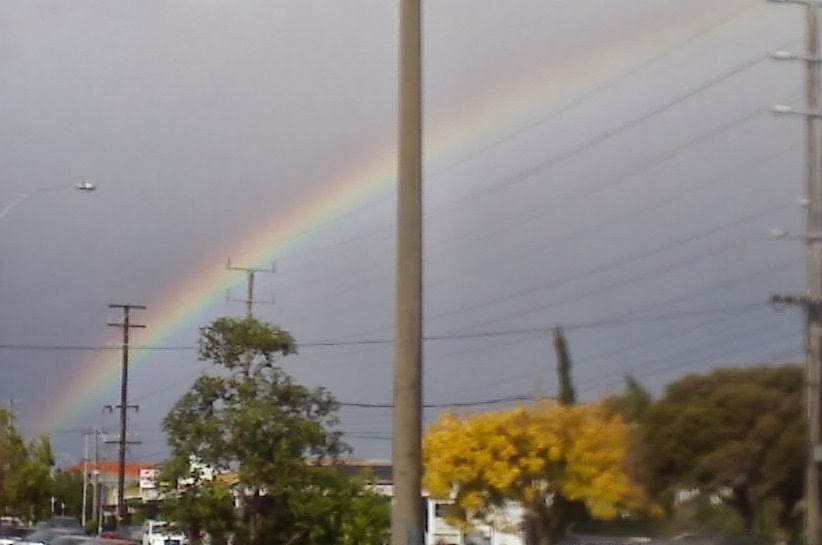
Rainbow over the minicipality

Rainbow over the minicipality

Monday, 2 January 2017

1017


Scene One is in a small cottage.  A few people are celebrating as a young couple have just announced they are to have a baby, and he is going to clear a plot of land that was never used and make a small farm for them, if they have the blessing of the village, because it is away from the Common and the Churchland, on the other side of the village, but still belongs to everyone.  People recall going there as children as a ‘dare’, and others have hunted there occasionally, but no one ever lived there. 
It is a small house, so we hear a lot of people outside who have come to congratulate the couple and agree to the land clearing.  Then along comes the local big wig, whom we also just hear outside that he too has come to give his blessings and agree to the land clearing, but then he tells how he heard when a small boy that there used to be someone living there who put a curse on it, which is what the children sometimes tell each other, and that is why his family always left it, because really it is theirs, even though the village thinks it belongs to them, like their common land in the middle of the village.  If this were an Opera, he would come on stage and sing this as an aria, but the aim here is to have a play with few actors but many characters.
The lower half of the stage has a black curtain across in front of it as the only light comes in from the window in the right, and to start that is little, but then bright lights are brought up to the window so they shine into the top part of the room.  Perhaps to start the room could be full of light, quickly fading into night as lamps and candles are lit on the floor, and the curtains could be lowered from above, and then when the lamps are raised and put up on shelves, the curtains could drop to the lower half of the stage, and then the setting sun could shine in the window, on the happy celebration till the sun sets and all is dark.  Then, in come children, who we hear but do not see as they are in the dark, below the light from the candles, which are high.  They share the good news and make plans for their studies with the teacher.
He tells of the new age they live in, where they need not believe old superstitions, and praises their ‘modern times’ and their expanding knowledge etc.  Perhaps a Priest or someone in the robes of some order with a cowl over their face agrees that ancient superstitions must be dropped but disagrees over the reason, not a secular modernism, recently learnt from the rediscovered Ancient Greeks, but faith in the beliefs of the Church.
Bright lights come up to the window and then in come Government Soldiers, who read a proclamation announcing all men between some ages are conscripted into the Army.  The new, young, father-to-be is grabbed and led away, with barely time for a parting kiss, being told, ‘you wont need to take anything where you are going.’  We hear others also being arrested outside, and cries of ‘What about the harvest?’ and ‘My baby!’  And suddenly there are only women on stage and a boy who is too short for us to see. 
The soldier looks down at him and then takes a bugle out of his bag and holds it up.  ‘Do you know what this is?’ ‘Could you play it?’  There are cries of ‘No!’ But then the soldier holds up a coin and the  is tempted.  The soldier says, ‘Put your lips together and put the bugle to your lips.  Keep your lips loose but keep the the bugle tight, and blow.’  He does and is grabbed and led away, ‘To blow the bugle’. And that is the end of him till the end of the play.
Suddenly it is quiet again and dark outside.  ‘My baby!’  ‘No, my baby!’  ‘They are all our babies!’ ‘Shall we ever see them again?’
‘What about the harvest?’ ‘We won’t need the extra field now.’ ‘Ah, that field. It is a good thing we are not disturbing that place, even if it was only good for scaring children.’  ‘The curse is real enough.’ ‘This might be a new age but we are foolish to abandon our old traditions.’ ‘You wouldn’t say these things if the Priest is around.’

Saturday, 24 December 2016

Lost Professions


Lost Professions
Our image of history, such as regularly represented through Visual Media, omits everything that has been forgotten.  We only see what we know for sure existed, and yet when we do the research we find that the popular image is quite wrong.
For example, the period of History that used to be called ‘the Dark Ages’ is usually portrayed as grey and sombre.  Churches in particular tend to be as grey as they are today, but a bit newer, and castles are invariably shown to have huge, stone walls inside all the rooms, with occasional, massive pieces of furniture.  However, the Late Middle Ages, approximately from 1070 to 1470 (1), was a very colourful period.  Churches had huge wooden screens that entirely filled the area from floor to ceiling and wall to wall between the Nave and the Transept, and it was all intricately carved and brightly painted.  Just as the Parthenon was brightly and by our standards garishly painted to the horror of the Romantic tourists who adore the weathered white.  Castles, did not have bare walls in the areas where the Upper Class lived, because they were always covered by tapestries or other wall hangings.  In Hamlet, hiding behind the arras is an important plot development.  The Churches were all stripped during the Reformation.  Anyhow, our popular idea is wrong on this, but it is not what I intended to write about.
Scriveners are a forgotten Profession that we rarely see in the background of scenes, because all Big Houses must have employed a team of people from the Estate to copy documents and write letters.  One could read and write oneself, but one would have staff who could read and copy accurately.  It must have been a common occupation.  We see women at spinning wheels or looms, or embroidering, but many must have sat at a table with a quill and ink.  Writing must have always been part of ‘women’s work’, but believed to be ignorant by men, they mostly were happy to let men think they were illiterate.  This is sure to have been the case when the men were themselves illiterate. (2)
I was going to write about various women’s activities especially in the largely women-only worlds of most villages and Big Houses, the two Social Structures of the Middle Ages.  Most men were away at Crusades or other military activities, or they were in Holy Orders.   Young aristocratic women must have enjoyed partying, as would women in the village, probably separately.  Women had what is called ‘cottage industry’ where they spun, wove and sewed in their own homes to provide the endless demand for new, pretty clothes for their ‘mistresses’.  Wagner’s Spinning Song is a good portrayal, but rarely on television or on the big screen have I seen much of this work happening. 
History was written by men and it is the men’s stories of kings and heroes and the big politics of States and estates, but life ‘at home’ went on in a traditional way for centuries, often oblivious to the goings on that eventually formed our historical knowledge and image of the periods.  Sometimes they collided, such as when an army marched through an area, say, down a valley, going from village to village, pillaging supplies and satisfying the soldiers’ carnal desires.  If people were really un-lucky, a battle would happen in their local fields.  Sometimes, someone’s son, brother or betrothed would be in one of the fighting armies.  But History isn’t usually written about ordinary people, except in the Fairy Stories.  Of course, the Big Houses were something else again.  A Big House was an entire community of people, not just the Aristocrats who ‘owned’ it.  Often they were associated with a village, though not all villages were connected to a Big House.  Most women would have been left pregnant, when their husbands went to war.  There must have been village commerce amongst these cottages of women, though all would have supported her own kitchen garden and been largely self-sufficient, with the help of her un-married daughters and her daughters-in-law. 
It may be stretching it too far to suggest that these lonely, Aristocratic, young women would not have wanted to nurse their own infants.  We know wet nurses existed, but they might have been something of a Profession, with village mothers that have weaned their own babies continuing to nurse ‘well bred’ babies of the Upper Class, to free their mothers for whatever frivolous activities such girls would have indulged in.
Footnote: (1) It would appear that in most centuries, it was around the year seventy of that decade when things changed.  Think of after the English Revolution and after the American Revolution.  British Australia was founded in the seventeen-seventies.  The Temple in Jerusalem was destroyed in the year Seventy.  It wasn’t till much later in the Eleventh Century that the first Crusade got going, changing Europe for ever, though the initial Call was a result of the Millenium itself, by some accounts.
(2) In Australian Mensa Inc, members whose wife is not a member have no problem both attending, but when the member’s husband is not a member, there is a tension that is often palpable, and such couples rarely return for more functions, though membership becomes more important after that as it is for most Mensans who never go to functions with other Mensans.

Thursday, 15 December 2016

Novel Numbers


Here is a new and novel idea about numbers, or I think it is new.  There is some debate about whether numbers, or which numbers, are ontological ‘things’. This is Mathematical Realism.   Perhaps only Prime Numbers have a life of their own, so to speak, as composite numbers can be assembled from them.  Fractions are created out of the prime numbers because they can be represented as a polynomial and even the transcendental numbers can be written as an infinite sum of numbers.  Philosophers from Kripke to Russell and with ever expanding, complex, new Number Theory, have grappled with accepting the ‘a priori’ truth of even the Number ‘One’ and from it the Number Line by assuming that non-existence has the ontological status of a number, called ‘zero’ to which One can be endlessly added.  But nothing is nothing, and we are imagining a continuum that in reality can only approach non-existence from either side but can never ‘not be’ because even the idea of something is a form of existence with ontological presence even if devoid of ‘substance’.  The Prime Numbers do appear to have real-world existence beyond our use of language and the ability to label things in useful ways.  Now, here is my new and novel idea.  It came to me while thinking of the pentagram, the five-pointed star that can be assembled into two different, regular three-dimensional objects.  The square root of five is an important number in this, so it occurred to me that perhaps it is the square root of five that is the real world phenomenon, not the integer five itself.  Then I thought how the square root of two is the length of the diagonal of a square.  That makes it exist in the real world in a fundamental way, as a length that exists for itself.  The number two, on the other hand, is a mental construct by people to count when there are a precise quantity of a multiplicity of single objects.  I say, ‘I have two hands,’ but I just have a hand and have another hand, the ‘twoness’ of my hands, their duality, is all in human imagination.  A similar argument for the diagonal of a cube that are the square root of three.  So, it is the square roots of numbers that are special,and exist in the real world in a way that our counting integers do not.